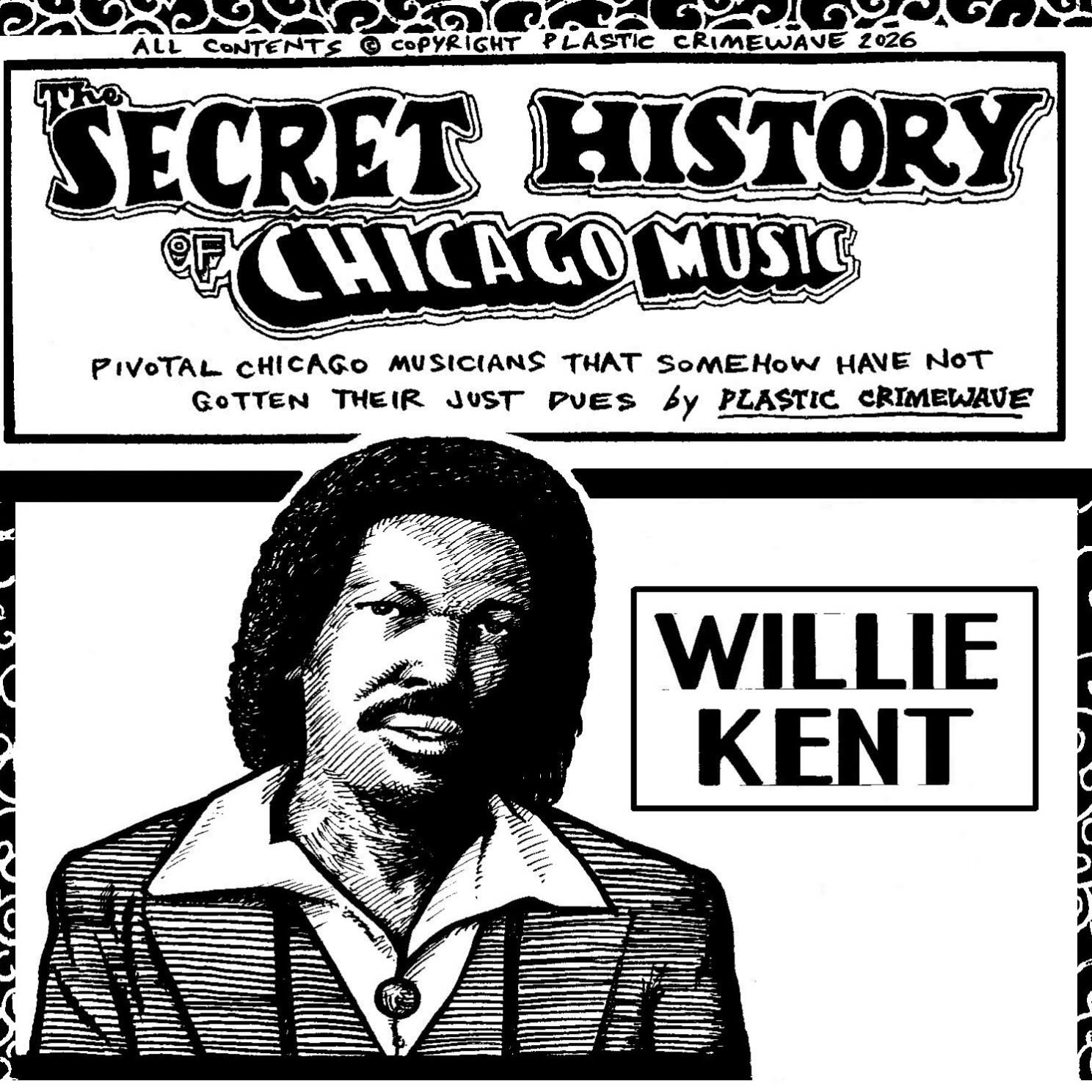
Bluesmen don’t come much more raw yet tight than the focus of the new Secret History of Chicago Music, Willie Kent. Hailing from the Delta, he picked cotton and split to Chicago as a teenager, where he became an in demand bassist, singer and bandleader. Kent played with all the greats, like Muddy Waters, Howlin’ Wolf, and Jimmy Dawkins. On vinyl, Kent also laid down some of the most immortal Windy City gutbucket blues documents. Get the story of this badass legend in the Chicago Reader!
The Secret History of Chicago Music
Willie Kent laid down a solid foundation for electric Chicago blues
The most reliable bassist in the genre deserves better than to fade into the background.
by Steve Krakow
October 26, 2026

Since 2005 Plastic Crimewave (aka Steve Krakow) has used the Secret History of Chicago Music to shine a light on worthy artists with Chicago ties who’ve been forgotten, underrated, or never noticed in the first place.
Chicago is an epicenter of the blues, and the Secret History of Chicago Music has covered plenty of obscure characters from the genre—though the meaning of “obscure” keeps getting broader as the blues becomes increasingly niche. I’ve been doing this for more than 20 years, and I’m still discovering legends such as bassist Willie Kent.
Kent isn’t exactly a secret to the Reader—he appeared in its pages several times before his death in 2006. But the paper’s own history is long enough that many of its past subjects have receded into the mists of time. The oldest Reader coverage of Kent that I could find online is from 1992, when blues scholar David Whiteis reviewed Kent’s Delmark Records debut, Ain’t It Nice. “Bassist Willie Kent is a genial, powerfully built west-side bluesman whose music reflects his personality: no-nonsense, sober minded, and unpretentious,” he wrote. “Kent’s voice . . . immediately evokes the sweaty informality of the west-side clubs.”
Bill Dahl, an equally formidable blues writer, described Kent even more succinctly in a 2001 Reader preview of the Chicago Blues Festival: “No Chicago blues bassist holds a groove steadier than Willie Kent.”
Kent’s bio at AllMusic, written by Jason Ankeny, takes a posthumous view of this heavy player. “The preeminent Chicago blues bassist of the postwar era,” he wrote, “Willie Kent was the city’s last surviving link to the Mississippi Delta tradition, backing a who’s who of immortals including Muddy Waters, Howlin’ Wolf, and Junior Parker as well as fronting his own long-running band, the Gents.”
Kent also got an obituary in UK newspaper the Guardian, a rarity for a Chicago blues musician who isn’t a household name. “Chicago’s pre-eminent blues bass player for 20 years, Willie Kent, who has died aged 70, was also one of the city’s most seasoned and respected bandleaders, and a sturdy singer as well,” wrote music historian Tony Russell. Clearly, Kent deserves the Secret History spotlight, to help keep his reputation shining bright.
Like many esteemed blues players, Kent was a native of the Mississippi Delta, raised by sharecropper parents. He was born in Inverness on February 24, 1936, and grew up in the Bolivar County town of Shelby (in the western Delta). He picked cotton from age six, and as a teenager he began listening to the famous radio show King Biscuit Time on Arkansas station KFFA. He thrilled to the sounds of Robert Nighthawk, Arthur “Big Boy” Crudup, and Sonny Boy Williamson I.
Kent sang gospel in the local church, and his neighbor Dewitt Munson introduced him to the blues. Munson would stop at the Kents’ porch on his way home at night, and he’d tell stories and let Kent hold his guitar. By age 11, Kent was a regular albeit covert guest at the Harlem Inn in Winstonville, known as “the showplace of the south,” which booked stars such as B.B. King, Little Milton, Bobby “Blue” Bland, Howlin’ Wolf, Tyrone Davis, Ike Turner, and T-Bone Walker. At age 13, Kent left home for Memphis, then worked briefly at a gas station in Florida. At 16, Kent traveled along what would later become famous as the Mississippi Blues Trail, relocating to Chicago in 1952.
Kent landed another day job and soon had enough money to buy his first guitar. He would loan it to bluesman Willie Hudson, and in return, Hudson would give him lessons. Kent worked hard, and by age 20, he could afford to bring the rest of his family to Chicago. One of his coworkers was a cousin to hugely influential slide guitarist Elmore James, and the underage Kent followed James from club to club to soak up his playing. He also saw the likes of Muddy Waters, J.B. Lenoir, Eddie “Playboy” Taylor, A.C. Reed, and J.B. Hutto.
In 1959, Kent began working as a chauffeur for Hudson’s band, Ralph & the Red Tops, occasionally hopping onstage to sing. “Whenever Hudson’s bassist brother showed up for a gig too drunk to perform,” Ankeny wrote,” Kent was summoned as his replacement, eventually taking over the position for good.”
In 1961, Kent joined the backing band of fellow Inverness native Little Milton, who was a couple years older and had already made a name for himself around the midwest as an R&B guitarist and singer. During the 1960s, Kent also gigged with Left Hand Frank (aka Frank Craig), Hip Linkchain, and Arthur Stallworth & the Chicago Playboys. He frequently made appearances at Kansas City Red’s “Blue Monday” parties.
As Kent’s stature grew throughout the decade, he also began traveling in more rarefied blues circles. He sat in with blues eminences such as Little Walter, Muddy Waters, Howlin’ Wolf, and Jimmy Dawkins. Kent regularly played with Dawkins at fabled club Ma Bea’s (3001 W. Madison). When Dawkins left to tour Europe in the early 70s, Kent took over his residency at the venue with own band, Sugar Bear & the Beehives, which included guitarist Willie James Lyons and drummer Robert Plunkett.
The band stayed at the club for six years, and on October 17, 1975, they recorded the LP Ghetto at Ma Bea’s. Billed to Kent and Lyons, it was Kent’s first album. It came out in 1976 on French label MCM Blues, and its cover bore the tagline “Direct from Chicago.” Kent and Lyons were joined by Tyrone Smith on drums and Big Guitar Red on guitar, with Luther “Guitar Junior” Johnson on a couple tracks. They played standards (Willie Dixon’s “Little Red Rooster,” Elmore James’s “Dust My Broom”) alongside originals (“Nineteen Years Old,” “Ghetto”).
At nearly eight minutes long, “Ghetto” is a master class. Kent’s soulful vocals lament and celebrate life on the wrong side of the tracks, while his tasteful but unstoppable in-the-pocket bass drives a hopped-up groove streaked with sizzling guitar leads. “Ghetto” should be universally recognized as a classic of raw, electric Chicago blues.
The title track of Willie Kent and Willie James Lyons’s 1976 LP Ghetto
In the early 80s, Kent joined the band of guitarist Eddie “Big Town Playboy” Taylor (father to blues musicians Eddie Jr., Larry, Tim, and Demetria). In July ’83 and August ’84, Kent recorded with a group billed as “the West Side Allstar Band” for Taylor’s album Bad Boy, released by Austrian label Wolf Records. This hot platter features vocals from Taylor’s wife, Vera, drums from his sons Tim and Larry, and guitar from Johnny B. Moore, a Delta-born player who was also in Koko Taylor’s group.
On Christmas Day in 1985, Eddie Taylor died of a heart attack. Kent recruited two players from his old boss’s band, Moore and Tim Taylor, for his own group, Willie Kent & His Gents. (Kent had formed the band in the late 70s, and it went through many lineups.) The Chicago scene was already becoming slick and tourist friendly, at least in spots, but Kent and his comrades stuck to classic, simmering west-side blues with a Delta flavor.
Willie Kent backs Eddie Taylor on this version of “All Your Lovin” from the early 80s.
In 1989, Kent underwent triple bypass surgery, after which he chose to leave his long-standing day job as a trucker and focus on music. After his recovery, Kent released his first album where he got top billing by himself, the 1989 release I’m What You Need. It came out on the local Big Boy label, run by DJ and producer Big Bill Collins, and features a guest appearance by pianist Barrelhouse Chuck.
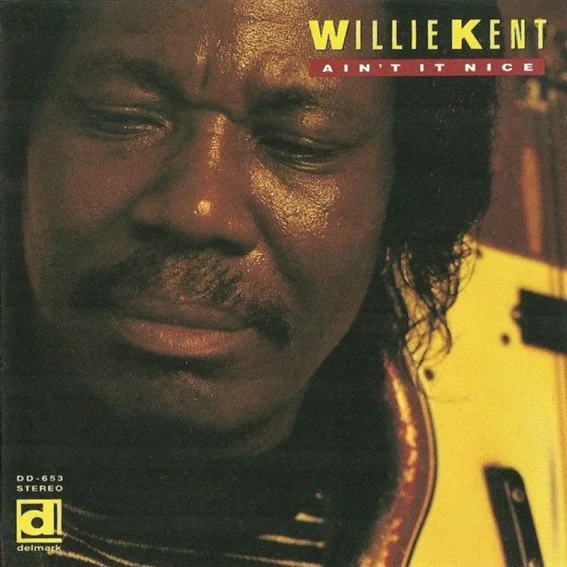
Kent’s four-album run on beloved Chicago label Delmark began with Ain’t It Nice in 1991. It showcases the savage harmonica of “Mad Dog” Lester Davenport and production by label boss Bob Koester, and it earned an award from the Library of Congress as the year’s best folk or blues recording.
Title track of Delmark 1991 album with Mad Dog Lester Davenport – AIN’T IT NICE!
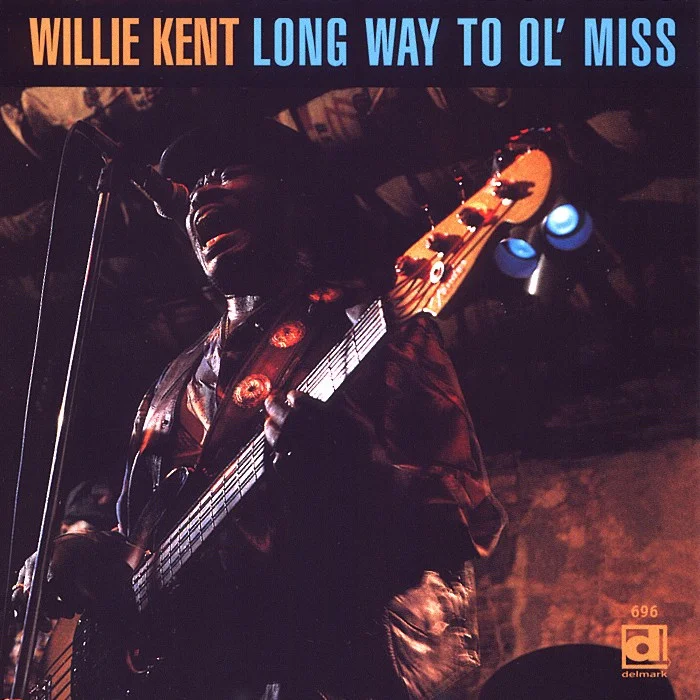
“All My Life” from Delmark’s 1996 album, LONG WAY TO OL’ MISS with Willie “Toothpick” Davis and Chico Banks on guitars
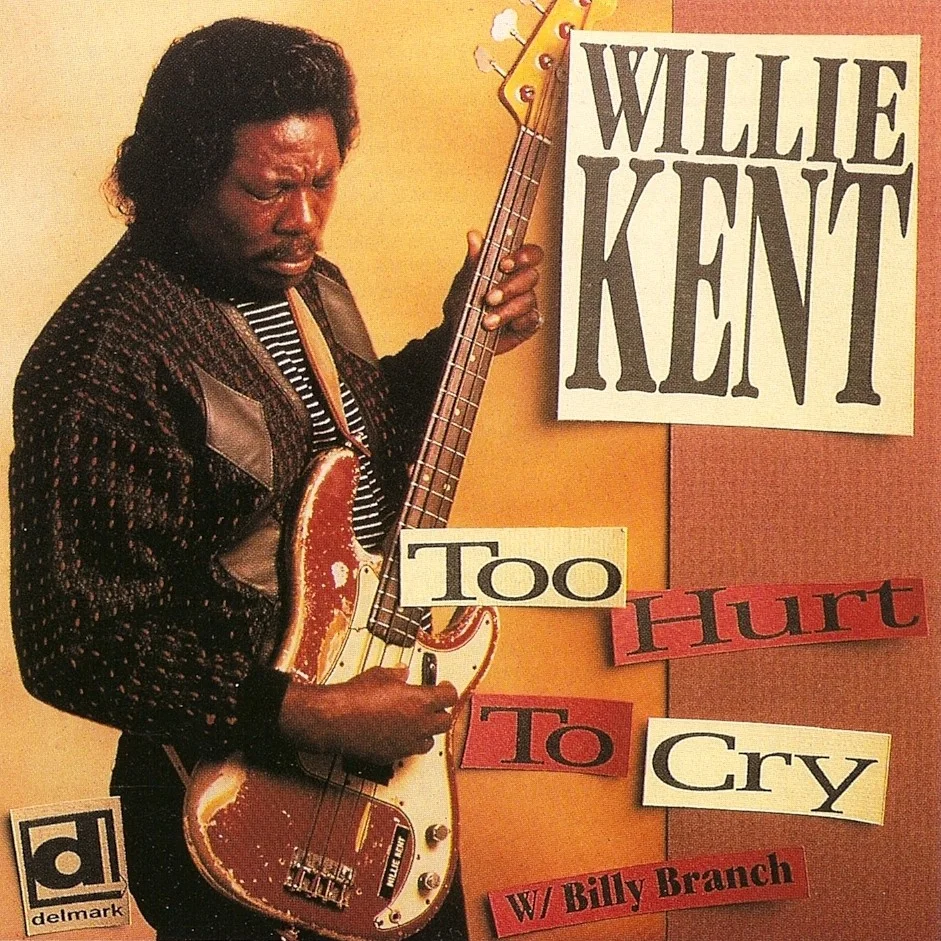
“911” from Willie Kent‘s 1994 Delmark album, TOO HURT TO CRY, with Billy Branch on harp and Johnny B. Moore on guitar!
Willie Kent’s 1991 recording of “Slow and Easy” features harmonica player Billy Branch.
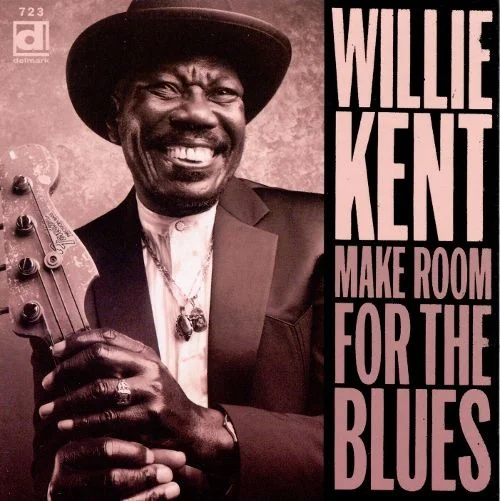
The other Delmark releases are 1994’s Too Hurt to Cry (with harmonica lord Billy Branch), 1996’s Long Way to Ol’ Miss (with young guitarist Vernon “Chico” Banks), and 1998’s Make Room for the Blues (with a horn section that included Willie Henderson on sax). Still a hard worker, Kent also recorded for Wolf, Earwig Music, and Blue Chicago during this period.
In 1995, Kent won the W.C. Handy Award for best blues bassist for the first of what would turn out to be ten times. That year he also received a similar award from Living Blues magazine, which he’d go on to win five more times.
In 2001, Kent released Comin’ Alive!, which he’d recorded at Twist Turner’s House of Sound, a local studio run by the veteran blues drummer and producer. It would turn out to be Kent’s last album as a bandleader.
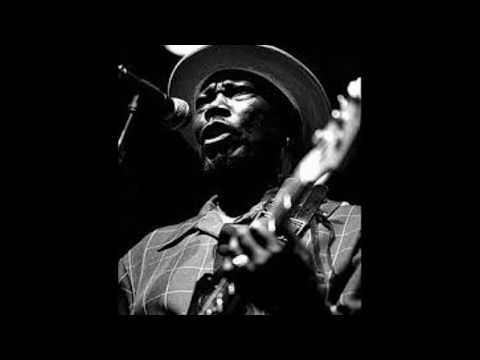
Whiteis recognized Comin’ Alive! as part of Kent’s effort to keep exploring new musical directions late in his career. “He handles stripped-down blues funk with the same unerring aplomb he brings to traditional postwar material,” he wrote in a 2001 Reader review of the album. “As a singer he’s learned to temper his leathery, declamatory bark with soulful tenderness.”
Kent was diagnosed with colon cancer in 2005 and began chemotherapy. He continued to play concerts, though to conserve his strength he quit playing bass and only sang. He succumbed to the illness on March 2, 2006, just a week after turning 70. He was survived by nine children and by his wife of 49 years, Ruth.
Willie Kent & His Gents onstage in Belgium in 2004
“In a music well stocked with mercurial personalities, Kent represented reliability and professionalism,” wrote Russell in the Guardian. “‘I like being on time, going to work, checking the instruments out, tuning it up,’ he told Living Blues magazine in 1993. His philosophy of bandleading was simple and decent. ‘Stay away from drugs. Give respect to everybody. Learn to follow and then to lead.’ His contemporaries held him in high regard for his thoughtful treatment of the musicians who worked with him.”
Russell also quoted Whiteis: “At least in public,” Whiteis wrote, Kent “radiated joy and power almost to the end.” Kent left this world showered in acclaim, and his music is such a reliable part of Chicago’s rich blues history that it can’t die.