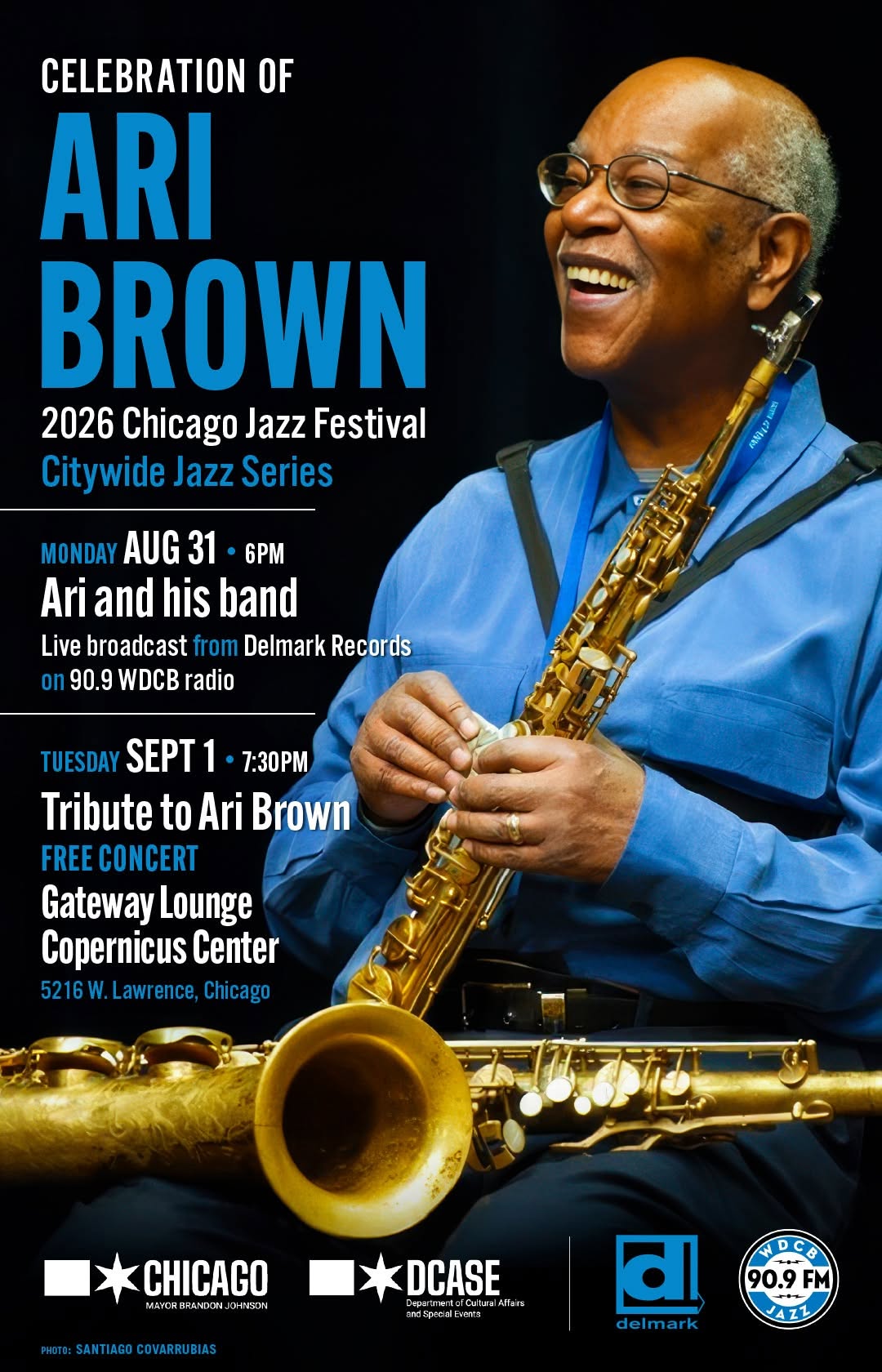
JOIN US FOR THESE TWO EVENTS CELEBRATING Chicago jazz saxophone legend, ARI BROWN:
The live broadcast on Monday and FREE concert on Tuesday will feature Ari Brown joined by longtime collaborators whose collective artistry has helped shape his unmistakable sound: pianist Kirk Brown, bassist Yosef Ben Israel, drummer Avreeayl Ra, and percussionist Dr. Cuz. Together, these musicians represent decades of shared musical experience, performing repertoire drawn from Ari Brown’s recordings, original compositions, and spontaneous improvisations that celebrate the creative freedom at the heart of Chicago jazz. Brief reflections from colleagues and friends will further illuminate Brown’s remarkable artistic journey and enduring influence.
Monday, August 31
Live broadcast from Delmark Records on 90.9 WDCB radio
- 6 p.m. – Celebration of Ari Brown
Tuesday, September 1, Free Concert
Gateway Lounge, Copernicus Center, 5216 W. Lawrence
- 7:30 p.m. – Tribute to Ari Brown
In addition to ARI BROWN, many other Delmark jazz artists are featured at this year’s festival, including JOSH BERMAN, JASON STEIN, COREY WILKES, DEE ALEXANDER, JOSHUA ABRAMS, JIM BAKER, and much more!
Chicago Jazz Festival
Thursday – Sunday, September 3-6, 2026
Thursday, Sept. 3: 11 a.m. – 9 p.m.
Friday, Sept. 4: 11:30 a.m. – 9 p.m.
Saturday, Sept. 5 & Sunday, Sept. 6: 11 a.m. – 9 p.m.
Citywide including Chicago Cultural Center & Millennium Park
FREE Admission
Millennium Park > Chicago Jazz Festival
Produced by the Department of Cultural Affairs & Special Events (DCASE) and programmed with the Jazz Institute of Chicago (JIC).
As in previous years, outside alcohol is not allowed in the Chicago Jazz Festival in Millennium Park but alcohol at various price points may be purchased inside the venue. Visit the Millennium Park Plan Your Visit page for more information.
The Chicago Jazz Festival is a Labor Day weekend tradition that promotes all forms of jazz through free, high-quality music programming. The festival showcases Chicago’s local talent alongside national and international artists to raise awareness and appreciation for one of the city’s most beloved art forms.
The City of Chicago’s Jazz Festival is presented by the Millennium Park Foundation with support from the Lloyd A. Fry Foundation.
Produced by the Department of Cultural Affairs & Special Events (DCASE)
Programmed with the Jazz Institute of Chicago
(schedule is subject to change)
Wed., Aug. 31 – 90.9 WDCB radio & Tues., Sept. 1 – Copernicus Center
Citywide Jazz Series
Monday, August 31
Live broadcast from Delmark Records on 90.9 WDCB radio
- 6 p.m. – Celebration of Ari Brown
Tuesday, September 1, Free Concert
Gateway Lounge, Copernicus Center, 5216 W. Lawrence
- 7:30 p.m. – Tribute to Ari Brown
Tuesday, September 1 & Wednesday, Sept. 2 – The Whistler
Citywide Jazz Series
The Whistler, 2421 N. Milwaukee Ave., Free Admission, 21+
Dynamic rhythm section Matt Ulery (bass) and Quin Kirchner (drums) lead an open jam session welcoming any and all jazz musicians to join in.
The Chicago Experiment is a Chicago-based organ trio led by Connor Bernhard on guitar, trumpet, compositions, and arrangements, with Zack Marks on drums and Andrew “Larry” Lawrence on Hammond B3.
Wednesday, September 2 – Fred Anderson Park
Live Free Jazz Concert
Fred Anderson Park, 1611 S. Wabash Ave., South Loop, Free Admission, All Ages Welcome
- 6 p.m. – Rempis/Abrams/RA + Baker
Begin your Chicago Jazz Festival week with a concert close to home.
Sponsored by The Birdhouse, DCASE and Your Fred Anderson Park PAC.

Thursday, September 3 – Chicago Cultural Center & Millennium Park
Chicago Cultural Center, Claudia Cassidy Theater, 2nd Floor North
- 3:45-4:45 p.m. – Music to Movies, Scoring Master Class with Robert Glasper
This year the Chicago Jazz Festival will continue to partner on the Chicago Jazz Institute’s program “What is This Thing Called Jazz?”
“WHAT IS THIS THING CALLED JAZZ?” will feature a Music to Movies Master class on Film Scoring with Robert Glasper. The goal of this event is to educate emerging and working musicians on how to get started in scoring, composing and syncing for film and tv.
Millennium Park, Jay Pritzker Pavilion
- 5:45-6 p.m. – Emcee Intro Remarks + National Anthem + Lift Every Voice
- 6-6:15 p.m. – 2 Brown Sisters: Maggie and Africa Brown
- 6:30-7:30 p.m. – Joel Ross Good Vibes
- 7:45-9 p.m. – Dee Dee Bridgewater & Bill Charlap Duo
Friday, September 4 – Millennium Park
Jay Pritzker Pavilion
- 3:45-4 p.m. – Emcee Intro Remarks + National Anthem + Lift Every Voice
- 4-4:45 p.m. – The Jo Ann Daugherty Trio with special guest, Henry Johnson
- 5:05-6:05 p.m. – Luciano Antonio Quintet
- 6:25-7:25 p.m. – Dr. Emma Dayhuff Innovations & Lineage: The Chicago Project featuring Dee Alexander, Corey Wilkes, Isaiah Collier, Michael King, and Jonathan Pinson
- 7:45-9 p.m. – Robert Glasper
Von Freeman
- 11:30 a.m. – 12:25 pm. – Stephen Parisi with Kabir Dalawari
- 12:40-1:35 p.m. – Lily Finnegan’s Heat On
- 1:50-2:45 p.m. – Maison Electronique
- 3-3:45 p.m. – Scott Burns Quintet
WDCB Jazz Lounge
- Noon – 1:45 p.m. – Chris Greene Quartet
- 2:15-4 p.m. – Raíces Latin Jazz Quintet
- 4:30-6:15 p.m. – Constantine Alexander Firetet
- 6:45-7:45 p.m. – Marlene Rosenberg Quintet
Saturday, September 5 – Millennium Park
Jay Pritzker Pavilion
- 3:45-4 p.m. – Emcee Intro Remarks + National Anthem + Lift Every Voice
- 4-4:45 p.m. – Prodigio Claudio
- 5:05-6:05 p.m. – Patricia Brennan Septet
- 6:25-7:25 p.m. – Paul Marinaro’s “Mood Ellington”
- 7:45-9 p.m. – M.E.B. (Miles Electric Band) celebrating The Miles Davis Centennial
Von Freeman
- 11:30 a.m. – 12:25 p.m. – Josh Berman & Jason Stein Quartet
- 12:40-1:35 p.m. – Kevin King Regime
- 1:50-2:45 p.m. – Joan Collaso
- 3-3:45 p.m. – Miguel de la Cerna Trio
Harris Theater Rooftop Terrace
- 11 a.m. – MYAC Jazz Combo
- Noon – 12:45 p.m. – Whitney Young High School Laflin Collective
- 1-1:45 p.m. – New Trier High School Jazz Ensemble 1
- 2-2:45 p.m. – Dekalb High School Jazz Ensemble
- 3-3:45 p.m. – Kenwood Academy High School Jazz Band
WDCB Jazz Lounge
- Noon – 1:45 p.m. – Gabriel Wade Quintet
- 2:15-4 p.m. – Ella Grace Sextet
- 4:30-6:15 p.m. – John Hanrahan Quartet (Coltrane Tribute)
- 6:45-7:45 p.m. – Frank Russell Quintet
Sunday, September 6 – Millennium Park
Jay Pritzker Pavilion
- 3:45-4 p.m. – Emcee Intro Remarks + National Anthem + Lift Every Voice
- 4-4:45 p.m. – Bruce Henry Quintet
- 5:05-6:05 p.m. – Isaiah Collier: “COLLIER plays COLTRANE”
- 6:25-7:25 p.m. – Bethany Pickens Soulful Coalition
- 7:45-9 p.m. – Paquito D’Rivera
Von Freeman
- 11:30-12:25 p.m. – M.A.D.D. Rhythms
- 12:40-1:35 p.m. – John Wojciechowski Quartet
- 1:50-2:45 p.m. – Chuck Webb and Guru Tonic
- 3-3:45 p.m. – Jeremiah Hunt
Harris Theater Rooftop Terrace
- 11 a.m. – Victoria Aliz Quintet
- Noon – 12:45pm – Blue Aura
- 1-1:45 p.m. – Miriam Goroff-Behel Quintet
- 2-2:45 p.m. – Michael Davenport Quartet
- 3-3:45 p.m. – Carmani Edwards
WDCB Jazz Lounge
- Noon – 1:45 p.m. – Arman Sangalang Quartet w/ special guest Jon Irabagon
- 2:15-4 p.m. – Alex Beltran (Sunday Soul)
- 4:30-6:15 p.m. – Michele Thomas Septet
- 6:45-7:45 p.m. – Ricardo Jiménez Quintet
https://www.chicago.gov/city/en/depts/dca/supp_info/chicago_jazz_festival.html
https://www.chicago.gov/city/en/depts/dca/provdrs/chicago_festivals/news/2026/may/jazz_festival.html
The Secret History of Chicago Music
Ari Brown belongs in Chicago’s canon of great tenor saxophonists
He hasn’t often sought the spotlight, but his blend of bebop rigor and avant-garde daring puts him on par with Fred Anderson and Von Freeman.
by Steve KrakowJuly 15, 2021
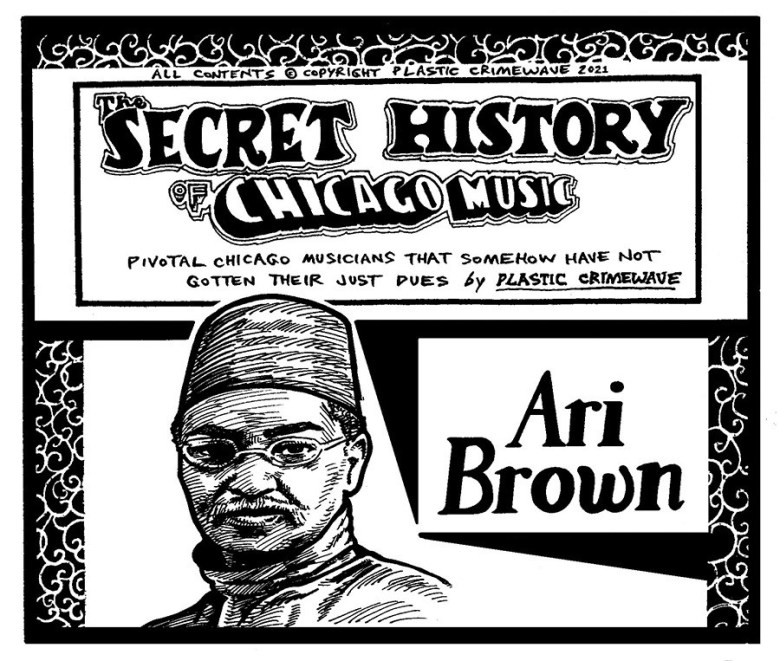
Since 2004 Plastic Crimewave (aka Steve Krakow) has used the Secret History of Chicago Music to shine a light on worthy artists with Chicago ties who’ve been forgotten, underrated, or never noticed in the first place.
The Windy City has lost most of its legendary tenor saxophone players: Gene Ammons, Johnny Griffin, Fred Anderson, Von Freeman. Luckily, several titanic Chicago saxophonists are still among us, including avant-jazz legend Roscoe Mitchell, genre-crossing out cat David Boykin, and the versatile but underappreciated Ari Brown, whose thoughtful playing bridges the nimble intricacies of bebop and the wooly eruptions of free jazz.
Brown was born February 1, 1944, and grew up on the south side of Chicago, where he learned to groove from his father’s jazz records. He began as a pianist, playing for soul, blues, and R&B artists around the midwest (Gene Chandler, the Chi-Lites, B.B. King, Lou Rawls, Chuck Berry, the Four Tops), and in 1965 he switched to tenor saxophone. At that point he was attending Woodrow Wilson Junior College (soon to be renamed Kennedy-King), where he met a crowd of future legends, including Jack DeJohnette and several founders or early members of the brand-new Association for the Advancement of Creative Musicians: Henry Threadgill, Roscoe Mitchell, Muhal Richard Abrams, and Joseph Jarman.
Brown would join the AACM himself in 1971, but he felt out of his depth at first. “The meetings were kind of intimidating to me, because all these musicians, they were already made musicians,” he told the Tribune‘s Howard Reich in 2018. “I was just a new face in the crowd. When I joined the group, Muhal wanted everyone to have a group and feature their own compositions and so forth. And I was really scared, because I hadn’t written a composition. I had never led a band before. So I’m not sure what I did. But I guess it worked.”
Revolutionary soul-jazz group the Awakening, which included several AACM affiliates (and appeared in a previous Secret History), enlisted Brown for its two groundbreaking albums, released via the Black Jazz label in 1972 and ’73. Sadly, in 1974 Brown suffered a major setback: a terrible car crash in which he lost several teeth. He was unable to play saxophone as he recuperated, so at first he fell back on his piano skills. After seven months, he tried to return to his horn and discovered that someone had added insult to injury—the instrument was gone, stolen from his home. Undeterred, Brown borrowed his father’s sax and got his chops back into shape.
In the late 1970s, Brown began playing mostly jazz, gigging with the likes of McCoy Tyner, Don Patterson, and Sonny Stitt. In 1979 the great drummer Elvin Jones asked him to be his touring saxophonist, a gig that would continue on and off for more than 20 years. All this time, Brown also held down a day job: he’d earned a bachelor’s degree in music education from the VanderCook College of Music in Bronzeville in 1968, and in 1974 he began work as a teacher for Chicago Public Schools. The multitasking Brown even appeared on the 1976 LP Flowers by Windy City soul and R&B group the Emotions, which went gold.
In the 1980s and onward, Brown would perform all over the world. He started his own regular group, the Ari Brown Quintet, and continued to gig widely with other projects and bandleaders. His resumé is vast, but highlights include the AACM Experimental Orchestra, the Art Ensemble of Chicago, Lester Bowie, Anthony Braxton (for his 1990s Charlie Parker Project), Donald Byrd, Malachi Favors, Von Freeman, Roscoe Mitchell, David Murray, Pharoah Sanders, Archie Shepp, and Orbert Davis‘s Chicago Jazz Philharmonic. In 1989 he joined drummer Kahil El’Zabar in his Ritual Trio, which is still active (albeit with a different lineup).
Though Brown appears on more than 75 records, he didn’t make an album as a bandleader until 1995. That year he recorded Ultimate Frontier for Delmark, working with several frequent collaborators: his brother Kirk Brown on piano, Yosef Ben Israel on bass, and Avreeayl Ra on drums. The music honored bop’s past while looking forward to the freedom music it had spawned, and it led to several more Delmark albums: 1998’s Venus, 2007’s Live at the Green Mill, and most recently 2013’s Groove Awakening.
Brown continues to teach, and has nurtured generations of musicians at Columbia College, the University of Illinois at Chicago, and other institutions. He’s played venues and events as diverse as the Smithsonian Institution, Steppenwolf Theatre, the Village Vanguard, the Newport Jazz Festival, and the North Sea Jazz Festival in the Netherlands. Despite working more as a sideman or in support roles than at center stage, Brown has received plenty of recognition throughout his career, including four awards from the National Endowment of the Arts. In 2018 the Tribune declared him one of its Chicagoans of the Year in the Arts.
Brown was part of the ensemble on the 2020 album Cloud Script by bassist Joshua Abrams, and he’s continued to perform as the pandemic allows. In March 2021, he and Kirk recorded a duo set at Constellation that was streamed as part of the virtual series Chicago Takes 10, and in April ’21 he played a string of limited-capacity shows at the Jazz Showcase. In June he participated in Elastic’s streaming Z Festival, playing in a band led by bassist Marlene Rosenberg, and on September 4 he’ll perform as part of a Millennium Park jazz concert during the Chicago in Tune festival. If you get a chance to catch this forward-thinking living legend onstage, don’t pass it up.
The radio version of the Secret History of Chicago Music airs on Outside the Loop on WGN Radio 720 AM, Saturdays at 5 AM with host Mike Stephen. Past shows are archived here.
City of Chicago Announces 2026 Chicago Jazz Festival Lineup Sept. 3-6, Featuring Dee Dee Bridgewater & Bill Charlap Duo, Robert Glasper, M.E.B. (Miles Electric Band) and Paquito D’Rivera
May 27, 2026
Bria Purdiman Bria.Purdiman@cityofchicago.org
DCASE Communications dcasepr@cityofchicago.org
Following Chicago’s Global Recognition as International Jazz Day Host City, Four Days of Free Performances at Millennium Park Celebrate Chicago’s Legacy as a Jazz Capital
CHICAGO — Mayor Brandon Johnson and the Chicago Department of Cultural Affairs and Special Events (DCASE) today announced the lineup for the 2026 Chicago Jazz Festival, presented by Wells Fargo, taking place Thursday, Sept. 3, through Sunday, Sept. 6, at Millennium Park, 201 E. Randolph St. The beloved Labor Day weekend tradition returns with four days of free performances featuring internationally acclaimed artists, celebrated Chicago musicians and rising talent.
“Chicago’s jazz legacy continues to shape the sound of music around the world, and the Chicago Jazz Festival is a celebration of the creativity, artistry and cultural spirit that define our city,” said Mayor Brandon Johnson. “This annual tradition brings together residents and visitors for unforgettable performances while honoring the generations of musicians who have made Chicago a global destination for jazz.”
“The Chicago Jazz Festival remains one of the city’s most treasured cultural traditions, bringing together legendary artists, innovative performers and audiences from across the globe for an unforgettable Labor Day weekend experience,” said DCASE Commissioner Kenya K. Merritt. “After an incredible roster of citywide programming that reflected Chicago’s jazz legacy for International Jazz Day, this year’s lineup showcases the incredible depth and diversity of jazz while continuing Chicago’s proud tradition of presenting free world-class arts programming in the heart of downtown.”
Produced by DCASE and programmed in partnership with the Jazz Institute of Chicago (JIC) and the Chicago Jazz Festival Committee, the Chicago Jazz Festival continues its tradition as one of the world’s premier free jazz festivals, spotlighting the city’s rich musical heritage while showcasing the evolving landscape of jazz. As the longtime programming partner for the Chicago Jazz Festival since 1979, JIC collaborates with DCASE to present an exceptional lineup of international, national, local and emerging jazz artists while continuing to celebrate and preserve the city’s rich jazz legacy.
“We are proud to continue our longstanding partnership with DCASE to bring the Chicago Jazz Festival to audiences from across the city and around the world,” said Heather Ireland Robinson, Executive Director of the Jazz Institute of Chicago. “This festival celebrates the extraordinary legacy of jazz in Chicago while creating space for innovation, discovery and the next generation of artists.”
The 2026 festival features an acclaimed slate of headliners at the Jay Pritzker Pavilion, including Grammy Award-winning vocalist Dee Dee Bridgewater performing with acclaimed pianist Bill Charlap on opening night, genre-defying pianist and producer Robert Glasper, M.E.B. (Miles Electric Band) celebrating the Miles Davis Centennial, and Grammy-winning clarinetist and saxophonist Paquito D’Rivera. Glasper will also kick off the festival on Thursday, Sept. 3, with a riveting “Music to Movies Scoring Master Class”.
Additional festival highlights include performances by Joel Ross Good Vibes; Dr. Emma Dayhuff Innovations & Lineage: The Chicago Project featuring Dee Alexander, Corey Wilkes, Isaiah Collier, Michael King, and Jonathan Pinson; Paul Marinaro’s “Mood Ellington”; Patricia Brennan Septet; Bethany Pickens Soulful Coalition and Isaiah Collier performing “COLLIER plays COLTRANE.” Festivalgoers can also enjoy the return of the WDCB Jazz Lounge, an intimate performance space featuring local jazz artists and emerging talent in a relaxed setting that celebrates Chicago’s vibrant jazz community.
As in previous years, outside alcohol is not allowed for the Chicago Jazz Festival, but alcohol may be purchased inside the venue. Before visiting, please be advised of other Prohibited Items at MillenniumPark.org. For Millennium Park safety and security information, visit the Plan Your Visit page of MillenniumPark.org.
2026 Chicago Jazz Festival Schedule – Jay Pritzker Pavilion
All performances are free and open to the public. Schedule subject to change.
Thursday, Sept. 3 – Opening Night
Millennium Park – Jay Pritzker Pavilion
201 E. Randolph St., Chicago, IL 60601
Programming 6-9 p.m.
- 6-6:15 p.m. – 2 Brown Sisters: Maggie and Africa Brown
- 6:30-7:30 p.m. – Joel Ross Good Vibes
- 7:45-9 p.m. – Dee Dee Bridgewater & Bill Charlap Duo
Friday, Sept. 4
- 4-4:45 p.m. – The Jo Ann Daugherty Trio with special guest, Henry Johnson
- 5:05-6:05 p.m. – Luciano Antonio Quintet
- 6:25-7:25 p.m. – Dr. Emma Dayhuff Innovations & Lineage: The Chicago Project featuring Dee Alexander, Corey Wilkes, Isaiah Collier, Michael King, and Jonathan Pinson
- 7:45-9 p.m. – Robert Glasper
Saturday, Sept. 5
- 4-4:45 p.m. – Prodigio Claudio
- 5:05-6:05 p.m. – Patricia Brennan Septet
- 6:25-7:25 p.m. – Paul Marinaro’s “Mood Ellington”
- 7:45-9 p.m. – M.E.B. (Miles Electric Band) celebrating The Miles Davis Centennial
Sunday, Sept. 6
- 4-4:45 p.m. – Bruce Henry Quintet
- 5:05-6:05 p.m. – Isaiah Collier: “COLLIER plays COLTRANE”
- 6:25-7:25 p.m. – Bethany Pickens Soulful Coalition
- 7:45-9 p.m. – Paquito D’Rivera
The Chicago Jazz Festival programming is generously supported by the following sponsors: 90.9fm WDCB, Capital Vacations, Chicago Jazz Publishing, Chicago Public Media, Chicago Transit Authority, Chicago Jazz Magazine, DownBeat Magazine, Humana, Lloyd A. Fry Foundation, Millennium Garages and Millennium Park Foundation.
Additional performance details will be announced at a later date. For more information, please visit ChicagoJazzFestival.us and Chicago.gov/DCASE.
Ari Brown Biography by Alex Henderson
Versatility has characterized the career of Ari Brown, a Chicago-based reedman and occasional pianist who plays hard bop and post-bop as convincingly as he plays avant-garde jazz. After growing up on the city’s South Side and graduating from high school in the early ’60s, Brown attended Chicago’s Wilson College, where he met Jack DeJohnette, Henry Threadgill, Roscoe Mitchell, Joseph Jarman, and others who would later become members of the Association for the Advancement of Creative Musicians (AACM). Brown played piano in mostly soul and blues bands until 1965, when he took up the sax and starting becoming seriously interested in jazz. In 1971, he joined AACM and made jazz his primary focus. Brown played sax on a few albums by a little-known group called the Awakening (who included bassist Rufus Reid), but after losing some teeth in a 1974 auto accident, he gave up playing the sax for about a year and played the piano exclusively. Brown made a full recovery, made the sax his main instrument once again and went on to work with players ranging from McCoy Tyner and Don Patterson to Sonny Stitt in the 1970s. The Chicagoan also kept busy during the 1980s, recording with Lester Bowie before being hired by Von Freeman, Bobby Watson, and Anthony Braxton (who hired him for his Charlie Parker Project). It was in 1989 that Brown began his lucrative membership in Kahil El’Zabar‘s Ritual Trio. But as long a resumé as Brown had as a sideman, he didn’t record as a leader until 1995, when he provided the diverse Ultimate Frontier for Delmark.
https://www.allmusic.com/artist/ari-brown-mn0000497298
Ari Brown (born February 1, 1944) is an American jazz tenor saxophonist and pianist.
Biography
Brown grew up in Chicago and attended Wilson College, where he met musicians such as Jack DeJohnette, Henry Threadgill, Roscoe Mitchell, and Joseph Jarman. He played piano in R&B and soul outfits into the 1960s, then switched to saxophone in 1965. He joined the AACM in 1971 and also played with The Awakening in the early 1970s. In 1974 he lost several teeth in a car crash and temporarily switched to piano again until he recovered. He played sax later in the 1970s with McCoy Tyner, Don Patterson, and Sonny Stitt. In the 1980s, he started his own quintet, and also worked with Lester Bowie, Von Freeman, Bobby Watson, and Anthony Braxton, and in 1989 he became a member of Kahil El’Zabar‘s trio. In 1995, he recorded his first album as a leader, titled Ultimate Frontier, and released by Delmark Records.
Discography
As leader
- 1995: Ultimate Frontier (Delmark Records)
- 1998: Venus (Delmark)
- 2007: Live at the Green Mill (Delmark)
- 2013: Groove Awakening (Delmark)
As sideman
With Joshua Abrams‘ Cloud Script
- Cloud Script (Rogueart, 2020)
With Dee Alexander
- Songs My Mother Loves (Blujazz, 2014)
With The Awakening
- Hear, Sense and Feel (1972)
- Mirage (1973)
With Anthony Braxton
- Anthony Braxton’s Charlie Parker Project 1993 (HatART, 1993 [1995])
With the Chicago Jazz Philharmonic
- Collective Creativity (2008)
With Orbert Davis
- Unfinished Memories (1994)
- Priority (2001)
- Blue Notes (2004)
With Kahil El’Zabar‘s Ritual Trio
- Alika Rising (Sound Aspects, 1990)
- Renaissance of the Resistance (Delmark, 1994)
- Big Cliff (Delmark, 1995)
- Jitterbug Junction (CIMP, 1997)
- Conversations (Delmark, 1999) with Archie Shepp
- Africa N’Da Blues (Delmark, 2000) with Pharoah Sanders
- Live at the River East Art Center (Delmark, 2005)
- Big M: A Tribute to Malachi Favors (Delmark, 2006)
- Follow the Sun (Delmark, 2013)
With Elvin Jones Jazz Machine
- Soul Train (1980)
With the Juba Collective
- Juba Collective (2002)
With Famoudou Don Moye
- Jam for Your Life! (AECO, 1985)
With Natural Information Society
- Simultonality (Eremite, 2017)
- Since Time Is Gravity (Eremite, 2023)
With Malachi Thompson
- Buddy Bolden’s Rag (Delmark, 1995)
- Blue Jazz (Delmark, 2003) with Gary Bartz and Billy Harper
With Frank Walton
- Reality (Delmark, 1978)