An all-star lineup of Chicago musicians to perform a night of protest songs past and present:
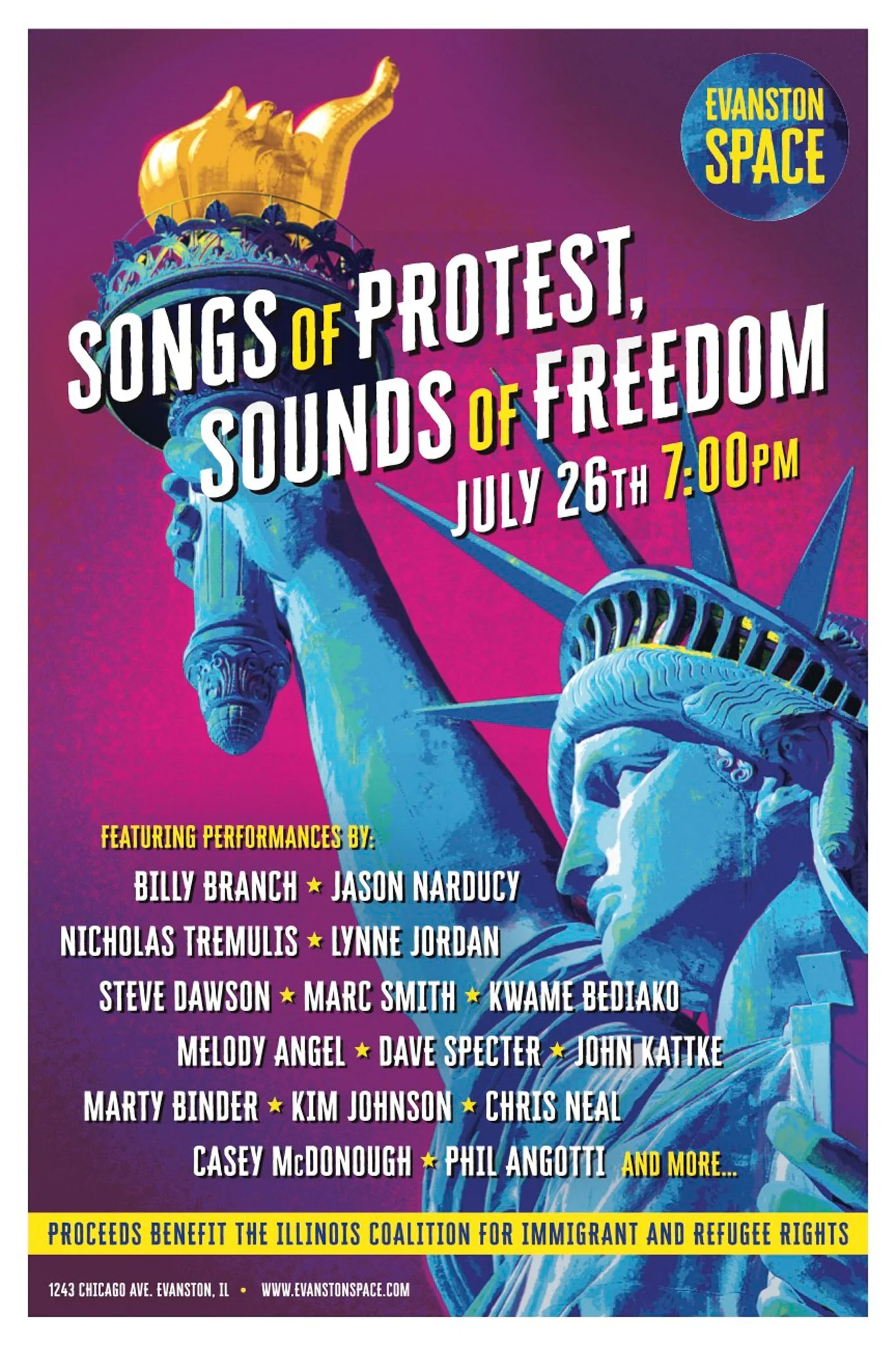
Dave Specter, Jason Narducy, Billy Branch and Melody Angel are among the nearly dozen music acts at Sunday’s “Songs of Protest, Sounds of Freedom” at Evanston’s Space.
https://chicago.suntimes.com/music/2026/07/23/protest-songs-concert-space-evanston
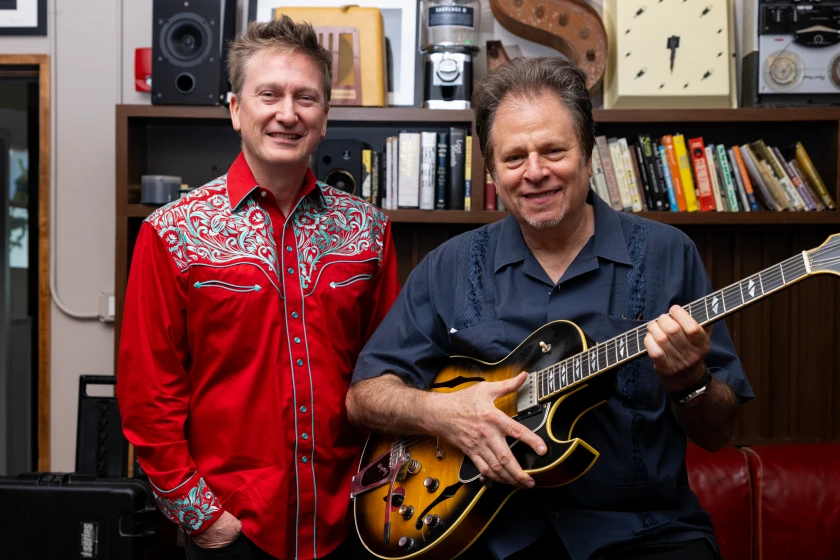
“Protest music has always been a part of the need to stand up against injustice and speak out,” musician Dave Specter (right) said. That’s why he organized “Songs of Protest, Sounds of Freedom,” on July 26 at Space in Evanston. Here, he’s pictured with punk songwriter Jason Narducy, who is on Sunday’s lineup.
Candace Dane Chambers/Sun-Times
Chicago Musicians Unite to Perform for Immigrant and Refugee Rights“Songs of Protest, Sounds of Freedom” was organized by Space co-owner Dave Specter, who was driven to action by ICE’s recent presence in Chicago communities.
by David Witter | July 21, 2026

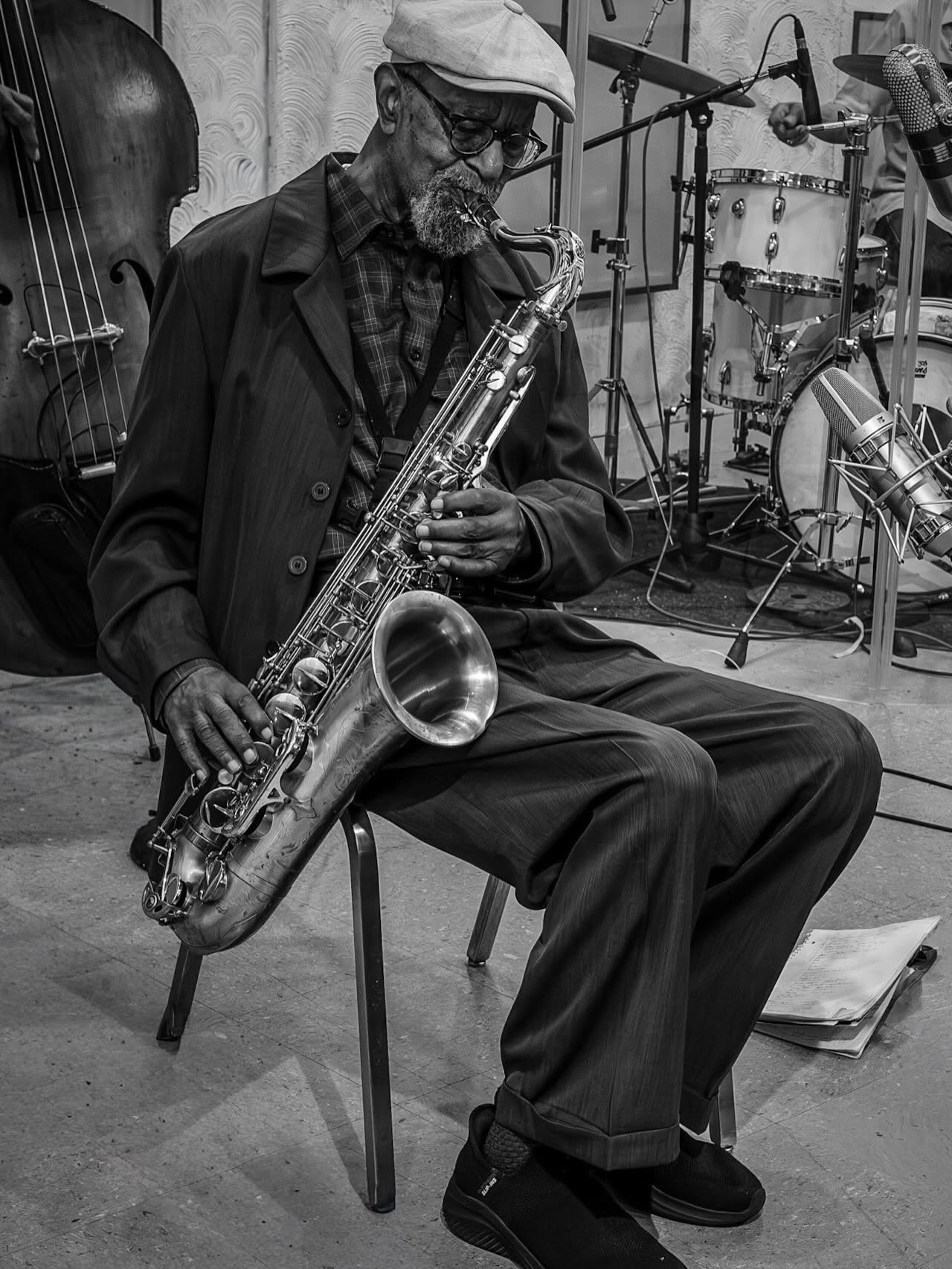
Billy Branch/Photo: Claudia Harrison
While not as strident or visible to mainstream America as the protest music in other genres, Chicago and Midwest-based blues artists contributed to the rising tide of protest beginning in the late 1950s with songs like “Vietnam Blues” and “Eisenhower Blues” by J.B. Lenoir, and John Lee Hooker’s “Build Myself A Cave” about avoiding the draft. In 1983, Sunnyland Slim released “Be Careful How You Vote.” That was the year Harold Washington became Chicago’s first Black mayor, winning a racially divisive race against Bernard Epton.
And though they say that politics divides and music unites, recent events on the streets of Chicago and Minneapolis as well as throughout the nation have combined music and politics in ways not seen since the 1960s. The most recent local manifestation of this is the upcoming concert, “Songs of Protest, Sounds of Freedom,” where local artists including Billy Branch, Nicholas Tremulis, Phil Angotti, Marc Smith, Kwame Bediako and a dozen more will be lending their talents to support the Illinois Coalition for Immigrant and Refugee Rights on July 26 at Space in Evanston.
“The name of the show was inspired by being part of the exhibit at the Woody Guthrie Museum, when my song that I wrote and recorded with Billy Branch called ‘The Ballad of George Floyd’ was in their exhibit called ‘Songs of Conscience, Sounds of Freedom,’” says Dave Specter, the organizer of the event and co-owner of Space. “But the main driver was seeing what ICE did this spring—they were in my neighborhood of Lakeview literally picking people off of the streets, violently, without due process, arresting friends of musicians that I knew, arresting people around the corner from where I live, near Belmont and Broadway—just the way ICE disrupted so many lives in horrible ways.” Specter worked in close coordination with Branch on both the “Ballad of George Floyd” and the show.

Dave Specter
Specter’s desire to speak out against injustice is shared by a medley of musicians from a vast array of genres and forms, such as blues artists like Branch, John Kattke and Marty Binder; soul and blues divas Melody Angel and Lynne Jordan; the Afro-reggae sounds of Kwame Bediako; alt-country performer Steve Dawson; the power pop of Phil Angotti, the poetry of Marc Smith; and the bass of Casey McDonough, whose band mate Joel Paterson was recently tapped to tour with Bob Dylan.
“We are going to have reggae; we are going to have poetry; Lynne Jordan is going to do some songs by Nina Simone, an artist who wrote and performed a lot of protest music having to do with the Civil Rights Movement,” Specter says. “We will also have Melody Angel, who is a blues rock artist who plays a lot of powerful and provocative music. Each artist will do one or two songs. Phil Angotti will be doing a couple of protest classics from back in the day. Nicholas Tremulis will be there. He is a great writer and performer and I am looking forward to him being a part of it. I think Steve Dawson and Nicholas will be playing solo, so it will be a combination of solo performers and band performers. I think seventeen total artists in all will be playing.”
Specter will also be performing at the show. Although he cut his teeth as a bluesman, backing up the likes of Hubert Sumlin, Son Seals and recording sixteen blues albums for Delmark Records, his musical influences also include protest music. Though Specter was too young to experience it firsthand, the stories Specter’s older brother told him about Chicago’s music venues like Alice’s Revisited and the clubs in Old Town always fascinated him.
“I myself was influenced by the protest music of Bob Dylan, Neil Young and the Staple Singers and even Phil Ochs, who was not as famous but very prominent in the anti-Vietnam War movement,” Specter says.
This influence can be heard on Specter’s latest single “The Times They Are Deranging (The Buck Stops Where?).” Performed with a soulful, gospel backdrop thanks to the organ of Brother John Kattke, Specter belts out lyrics like “took to Twitter like a cat on litter” and “don’t be quiet, we’ve go to fight it.”
Although not quite as large and wide in scope as the protest festivals and “be-ins” of the 1960s, this cadre of local musicians not only see one political vision, but are uniting to act as one.
“One thing music does is it brings us together in a peaceful way,” Specter says. “I think this event will feature artists who are both celebrating with music and speaking out against issues that are upsetting a lot of people in this country right now.”
SPACE to hold benefit concert for immigrant rights organization on Sunday

For Dave Specter, protest songs have carved out a special place in his life.
Specter, the co-owner of the Evanston performing venue SPACE, grew up in a musical family in the 1960s and 1970s where protest songs from the likes of Bob Dylan, Neil Young, The Staple Singers and Woody Guthrie were celebrated.
These songs materialized into real actions in his family when his older brother protested the Vietnam War and his father worked as a community organizer in Chicago, Specter said.
Today, his world view is still enhanced through the lens of protest music, and he called the actions of the federal government “disturbing.” To Specter, federal immigration enforcement has had a significant impact on the Evanston and Chicago community he knows.

For Specter, the best way to make your voice known during times like these is through music.
“I think that when we see injustice in the world, music is a strong, powerful and peaceful way to speak out about it,” he said.
This Sunday, July 26, SPACE, 1243 Chicago Ave., will hold a large benefit concert titled “Songs of Protest, Sounds of Freedom,” which will include a wide variety of genres including blues, folk, jazz, reggae, rock and poetry, with the aim of speaking out against current events in the country.
Proceeds from the event will be donated to the Illinois Coalition for Immigrant and Refugee Rights, an organization that works to ensure equitable policies for immigrant communities.
The bill includes 15 artists from the Chicago area, as well as more performers not advertised on the flyer, according to SPACE’s website. Doors open at 6 p.m. and music starts at 7 p.m. Tickets are $33.90, including fees and taxes, and the show is open to all.
According to Specter, SPACE has hosted similar fundraisers and benefit shows for other organizations and nonprofits in the past, including one for James B. Moran Center for Youth Advocacy in Evanston, an organization that provides legal, social work and other services for youth and their families.
Specter said there was a unanimous “yes” from all the musicians to be a part of this event, and said no one thought twice about it.
“I think it’s our responsibility as musicians and as citizens to speak out. That’s what America is about,” Specter said. “I think that’s one of the reasons so many musicians came on board immediately.”
Lynne Jordan, a singer who will perform at the upcoming show, said Specter reached out to her to be a part of the event. To her, saying yes was a no-brainer, seeing as she will be performing two protest songs by Nina Simone.
The overarching concept of freedom in the upcoming show is personal to Jordan and goes back generations in her family. Jordan said her great-grandmother was a slave in Georgia, and her grandfather fled a lynch mob in Georgia and relocated to Ohio and became a preacher.
“I’m very tuned into protests, and I’m watching so many human rights be violated,” Jordan said. “I’m happy to do my little part.”
Billy Branch, another musician who will be performing Sunday, goes back musically with Specter. The two worked together on the song The Ballad of George Floyd, which was released in 2020.
George Floyd, a 46-year-old Black man, was killed by Minneapolis police officer Derek Chauvin on May 25, 2020. Chauvin was later convicted of murder and manslaughter in Floyd’s death. Floyd’s murder sparked protests around the world against police brutality and racial injustice.
Branch will be performing two songs at the upcoming concert, the original-titled track from his newest album, The Blues is My Biography, as well as The Ballad of George Floyd.
Branch, who describes himself as being very political, said he is looking forward to performing on the bill because he is concerned about the state of the U.S. To him, musicians have the easiest way to express themselves, which is through their songs.
“Given these challenges to our freedom in this country, it’s very important that we speak up or push back,” he said.
Specter quoted John Lewis, the late civil rights activist and former U.S. Representative from Georgia, in conjunction with his excitement for the event.
“He spoke of the power of music during the Civil Rights era,” Specter said. “Lewis said, ‘If it hadn’t been for music, the Civil Rights Movement would’ve been like a bird without wings.’ That stuck with me, [and] I just hope that music — in some way — can help bring about change.”bring about change.”